Table of Contents >> Show >> Hide
- Before You Shift: What’s Actually Happening Under the Hood
- 1) The Everyday Upshift (The “Normal” Way)
- 2) The Simple Downshift (Smooth and Street-Friendly)
- 3) Rev-Matched Downshifting (The “Throttle Blip”)
- 4) Double-Clutching (Old-School Smoothness, Modern Use Cases)
- 5) Heel-Toe Downshifting (Advanced Coordination)
- Common Manual Shifting Problems (and Fast Fixes)
- A Simple Practice Plan (So You Actually Improve)
- : Real-World Shifting Experiences (What It Feels Like)
- Conclusion: Pick the Right Shift for the Situation
Driving a manual is a little like playing drums: your hands and feet are doing different jobs, on purpose,
at the same time, without starting a small neighborhood panic. The good news? Once your brain turns the
motions into muscle memory, it becomes weirdly satisfyinglike landing a perfect high-five with the car.
This guide breaks down five practical ways to shift a manual transmission, from everyday
upshifts to smoother downshifts and a couple of “advanced moves” you’ll mostly want to practice off public
roads. We’ll keep it clear, safe, and genuinely usefulno mystical “become one with the clutch” fluff
(okay, maybe a tiny bit).
Safety note: Practice new techniques in an empty parking lot or on quiet roads, obey traffic laws, and never experiment in heavy traffic.
Before You Shift: What’s Actually Happening Under the Hood
A manual transmission connects your engine to the wheels through a clutch and a set of gears. When you
press the clutch pedal, you temporarily disconnect the engine from the drivetrain so you can select a
different gear. When you release the clutch, the connection returns.
The “bite point” is your new best friend
The clutch doesn’t act like an on/off light switchit’s more like a dimmer. The bite point
(also called the friction point) is where the clutch starts to grab and the car begins to move. Getting
smooth shifts is mostly about learning where that point is in your car.
Why smooth shifting matters
Modern manuals have synchronizers that help match speeds between gears for clean engagement. Smooth shifting
reduces wear on the clutch and helps the synchronizers do their job without being bullied. Think “firm and
gentle,” not “fast and furious.”
1) The Everyday Upshift (The “Normal” Way)
This is the shift you’ll do most: moving from a lower gear to a higher gear as you accelerate (1st → 2nd → 3rd, and so on).
The goal is simple: disconnect, select, reconnectsmoothly.
Step-by-step: a clean upshift
- Accelerate in your current gear until the engine sounds like it’s ready for the next gear (or your tach suggests it).
- Ease off the gas with your right foot (don’t keep pushing it while shifting).
- Clutch in smoothly and fully with your left foot.
- Shift to the next higher gear in one confident movement (no “stirring soup”).
- Clutch out smoothly while reapplying gentle throttle to match the car’s new gear.
What it should feel like
A good upshift feels like the car simply continues forwardno head bobble, no dramatic lurch, no passengers
suddenly texting their therapist.
Quick tips for better upshifts
- Don’t ride the clutch: once you’re fully in gear, get your foot off the clutch pedal.
- Don’t rest your hand on the shifter: it can add pressure to the shift mechanism over time.
- Shift timing is flexible: every engine and gear ratio is different, so listen and feel instead of chasing one magic RPM number.
2) The Simple Downshift (Smooth and Street-Friendly)
Downshifting means moving to a lower gear when you’re slowing down or you need more power at a lower speed.
For everyday driving, the main goal is control and smoothnessnot proving you’ve watched
47 racing videos at 2 a.m.
When to use a basic downshift
- Slowing for traffic or a turn
- Climbing a hill where the engine feels weak (“lugging”)
- Needing quick acceleration without flooring it in a high gear
Step-by-step: basic downshift
- Lift off the gas and begin slowing with the brake if needed.
- Clutch in fully.
- Shift to the next lower gear (e.g., 4th → 3rd).
- Clutch out smoothly. If you’re not adding throttle, do it gently to avoid a jerk.
Street reality: you don’t have to downshift for every stop
Many drivers use the brakes to slow and shift to neutral as they approach a stop, especially if they’re still
developing smooth downshifts. The safest approach is the one that keeps you stable, predictable, and in control.
If you do coast in neutral, do it only when appropriate and legal where you driveand avoid rolling downhill
in neutral, which can reduce control.
3) Rev-Matched Downshifting (The “Throttle Blip”)
A rev-matched downshift is a downshift where you briefly raise engine RPM during the shift so the engine speed
better matches the lower gear. Result: less lurching, smoother engagement,
and less strain on the clutch and driveline.
Why rev matching works
When you shift into a lower gear at the same road speed, the engine needs to spin faster. If you just release
the clutch without matching RPM, the car forces the engine to speed up, which can feel like a sudden tug.
Rev matching helps the engine “meet the gear halfway.”
Step-by-step: rev-matched downshift (everyday version)
- Begin slowing (if needed) and clutch in.
- Shift to the lower gear.
- While the clutch is still in, give a quick, small throttle blip (a short tap of the gas).
- Release the clutch smoothly as the revs settle into the right range.
A simple example (numbers are just illustrative)
Say you’re cruising around 35 mph in 3rd gear at roughly 2,000 RPM. If 2nd gear at 35 mph would put you around
3,000 RPM, your quick blip aims to lift the engine closer to that number before you let the clutch out.
Done right, the car stays calmno dramatic forward nod.
Common rev-matching mistakes
- Over-blipping: too much throttle makes the engine flare and can feel jumpy.
- Dumping the clutch: smooth release matters as much as the blip.
- Downshifting too early: if the lower gear would push RPM too high, don’t force it.
4) Double-Clutching (Old-School Smoothness, Modern Use Cases)
Double-clutching is a technique where you use the clutch twice during a shiftonce to move into neutral and
again to move into the target gear. It’s essential for older non-synchronized transmissions and can still be
useful for extra-smooth downshifts or when a gearbox is picky.
Why double-clutching exists
Synchronizers in modern transmissions help match gear speeds automatically. Double-clutching helps do some of
that work manually by matching the transmission input speed more closely before selecting the next gear.
Step-by-step: double-clutch downshift
- Clutch in and shift to neutral.
- Clutch out (yes, still in neutral).
- Blip the throttle to raise engine speed (this also raises input shaft speed).
- Clutch in again, shift into the lower gear.
- Clutch out smoothly and continue driving.
When it’s actually worth doing
- Older vehicles (especially if the gearbox is worn or notchy)
- Situations where a downshift feels resistant or rough (without forcing it)
- Drivers who want to be gentler on synchronizers over the long haul
You don’t need to double-clutch every timethis isn’t a historical reenactment. But it’s a great tool to know.
5) Heel-Toe Downshifting (Advanced Coordination)
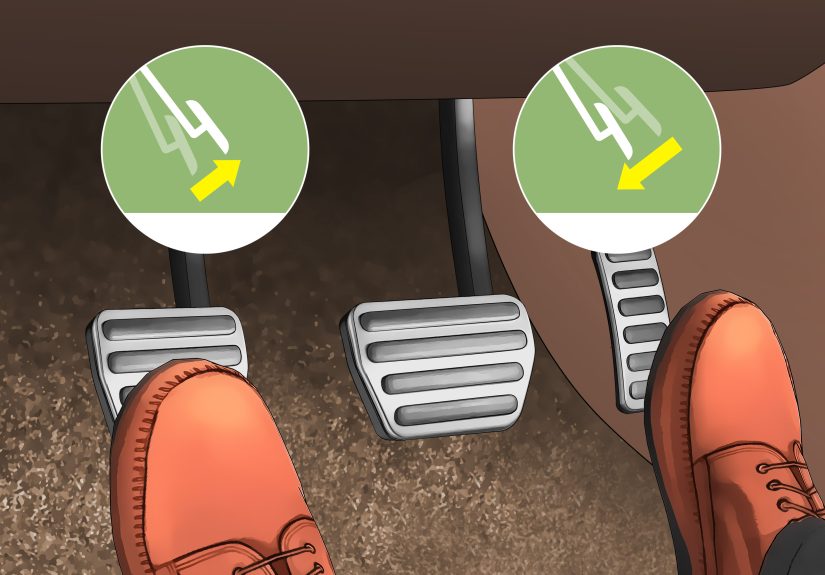
Heel-toe downshifting combines braking and rev matching at the same time by
using one foot to press the brake while also “blipping” the throttle. It’s mainly used in performance driving
so the car stays balanced while slowing and selecting a gear for corner exit.
Important: This is an advanced technique. Learn it only after you can rev-match confidently,
and practice it in a controlled environment (like a closed course), not in traffic.
The idea in plain English
You’re braking, you want a lower gear, and you want the downshift to be smooth. So you keep steady brake
pressure while you briefly tap the throttle during the shift. The reward is stability and smoothness.
Common “gotchas”
- Pedal layout varies: some cars make heel-toe easy; others make it feel like trying to play piano in boxing gloves.
- Brake consistency matters: sloppy braking while learning defeats the purpose.
- Start slow: build coordination first, speed laterif ever, and only where appropriate.
Common Manual Shifting Problems (and Fast Fixes)
“I stall all the time.”
Totally normal at the beginning. The fix is almost always: slower clutch release at the bite point,
and a tiny bit more throttle. Also check your seating positionif you can’t fully press the clutch,
you’re fighting the car with bad leverage.
“My shifts are jerky.”
Jerks usually happen when engine speed and wheel speed aren’t lining up during clutch engagement. Focus on:
(1) smoother clutch release, (2) gentler throttle reapplication, and (3) rev matching for downshifts.
“I grind gears sometimes.”
Grinding is the transmission’s way of saying, “Please stop doing that.” Common causes include not pressing
the clutch fully, rushing the shift, or forcing a gear when speeds don’t match. If it resists, don’t muscle it.
Reset to neutral, clutch in, and try again calmly.
“Should I skip gears?”
Skip-shifting can be fine in gentle driving (like going 2nd → 4th once you’re cruising), but the key is RPM:
choose a gear that won’t lug the engine. For learning, stick to sequential shifts until you’re consistent.
A Simple Practice Plan (So You Actually Improve)
Session 1: Bite point and smooth starts
- Find a flat, empty area.
- Practice releasing the clutch to the bite point without adding much throttle.
- Repeat until you can start moving without stallingor launching like a startled rabbit.
Session 2: Upshifts at low speed
- Practice 1st → 2nd → 3rd with gentle acceleration.
- Focus on smoothness, not speed.
Session 3: Basic downshifts
- Practice slowing and selecting a lower gear without jerking.
- Then introduce small rev-match blips once the basic motion feels steady.
: Real-World Shifting Experiences (What It Feels Like)
Almost everyone’s first manual-transmission experience includes a highlight reel of “educational moments.”
You stop at a light, the light turns green, and your brain suddenly forgets what feet are. The car stalls.
The person behind you honks. You apologize to the universe, restart, and promise yourself you’ll master this
ancient art like a calm, capable adult. Then it stalls again. Welcome to the club.
The big early breakthrough is learning that the clutch isn’t a trapdoorit’s a transition. The moment
you start treating the bite point like a place you can “pause” for a half-second, everything changes.
Instead of dumping the clutch and hoping for the best, you ease into engagement, feel the car start to move,
and add a little throttle like you’re gently turning up the volume. Your starts stop feeling like a rodeo.
Upshifts become your next “aha.” At first, new drivers often do the manual equivalent of patting their head,
rubbing their stomach, and trying to text at the same time. The car jerks because the clutch comes up faster
than the engine is ready, or the gas comes back on too aggressively. With practice, you start noticing the
rhythm: lift off the gas, clutch in, shift, clutch out, add throttle. It’s one fluid motion, not five separate
tasks. The day your passenger doesn’t notice you shifted? That’s the day you quietly win.
Downshifts are where people either fall in love with manuals or swear them off forever. The first time you
downshift without rev matching, the car may lurch like it just remembered an embarrassing memory. That’s when
you realize rev matching isn’t just for race driversit’s for anyone who prefers their coffee inside
the cup. You try a small throttle blip, release the clutch smoothly, andboomthe car stays composed. It’s a
tiny moment of mechanical harmony, like the drivetrain just nodded at you in approval.
Eventually, you start reading the car like a conversation. You can hear when the engine is working too hard
in a high gear and needs a downshift. You can feel when you’re rushing a shift and the gearbox wants a fraction
more patience. And you learn a final, underrated manual-driving life skill: staying calm. Because nothing makes
shifting worse like panic-shifting in traffic. The best manual drivers look unbothered, not because they’re
showing off, but because smooth inputs come from a relaxed body.
The funniest part? Once you get good, you’ll forget it was ever hard. You’ll hop into an automatic, rest your
left foot somewhere, and think, “Wait… what do I do with this extra foot?” That’s when you know the stick shift
has officially moved into your muscle memoryand possibly your personality.