Table of Contents >> Show >> Hide
- Why Your Degree Format Matters
- What Employers Usually Expect to See
- Way #1: Write the Full Degree Name
- Way #2: Use the Degree Abbreviation
- Way #3: Show a Degree in Progress
- Way #4: List an Unfinished Degree, Alternative Credential, or Multiple Academic Credentials Strategically
- How to Choose the Best Format for Your Resume
- Common Mistakes to Avoid
- Sample Education Section Templates
- 500 More Words of Real-World Experience and Resume Lessons
- Conclusion
- SEO Metadata
Writing your degree on a resume sounds like one of those tiny details you can handle in seven seconds while half-asleep and reheating coffee. Then you open a blank document, type “Bachelors??” delete it, type “Bachelor’s?” delete it again, and suddenly you are having an identity crisis over punctuation. Relax. This is fixable.
Your education section does more than announce where you went to school. It tells employers whether you have the credential they need, whether you understand professional formatting, and whether you can present information clearly without making a hiring manager squint like they are decoding an ancient tablet. The good news is that there is no single magical format. The even better news is that there are smart, standard ways to do it.
In this guide, you’ll learn four clean ways to write your degree on a resume, when each format makes sense, what mistakes to avoid, and how to handle awkward situations like an unfinished degree, multiple majors, certificates, or graduation that is still somewhere on the horizon. Think of this as a degree-formatting survival kit, minus the camping gear.
Why Your Degree Format Matters
Employers and recruiters typically scan resumes quickly, so your education section has to deliver useful information fast: your school, your degree, your major, and your graduation date or expected graduation date. If those pieces are vague, inconsistent, or buried under unnecessary wording, your resume starts losing points before your experience section even gets a chance to show off.
A strong education section also helps with applicant tracking systems, or ATS. These systems tend to prefer standard headings, simple formatting, and familiar language. In plain English: if your degree is written clearly, your resume is easier for both software and humans to understand. That is the hiring equivalent of being the person who actually labels leftovers in the office fridge.
What Employers Usually Expect to See
Before we get into the four formats, here are the basics most resumes should include in the education section:
- School name
- City and state
- Official degree title
- Major and, if relevant, minor or concentration
- Graduation date or expected graduation date
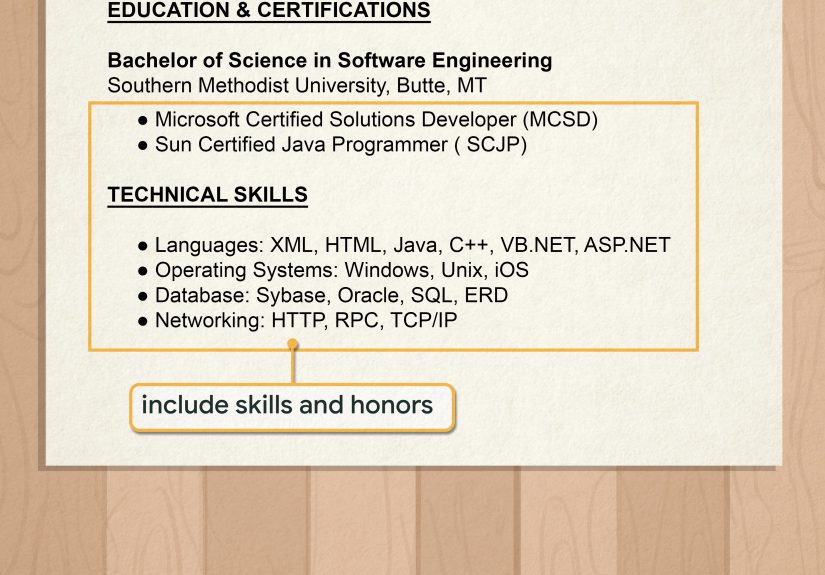
- Optional extras such as GPA, honors, certificates, relevant coursework, or study abroad
If you have multiple degrees, list the most recent one first. If you are already in college or have graduated, high school usually does not need to stay on the resume. And if your GPA is solid and relevant, it can help. If it is not doing you any favors, it does not need a starring role.
Way #1: Write the Full Degree Name
This is the safest, clearest, and most professional option for most job seekers. Writing out the full degree name removes confusion and makes your education section easy to read at a glance.
Best for:
- Students and recent graduates
- Traditional one-page resumes
- Applications where clarity matters more than saving space
- ATS-friendly formatting
Example:
University of Texas at Austin, Austin, TX
Bachelor of Science in Biology
May 2025
This format works because it gives the employer the exact credential, not a puzzle. “Bachelor of Science in Biology” is immediate and specific. Nobody has to guess whether “B.S.” means Bachelor of Science or whether you accidentally typed your favorite TV network.
Why this format works so well
It looks polished. It mirrors how universities officially name degrees. It also gives you room to add details naturally, like a minor, certificate, or honors distinction.
Expanded example:
University of Florida, Gainesville, FL
Bachelor of Arts in English, Minor in Digital Media
May 2026
GPA: 3.7/4.0
Honors: Dean’s List, 2024–2025
Use this version when you want the education section to do a little more heavy lifting. For students, career changers, and recent grads, that is often a smart move.
Way #2: Use the Degree Abbreviation
Sometimes space is tight. Maybe your resume already contains internships, projects, research, leadership, certifications, and the volunteer role where you somehow ended up running a fundraising spreadsheet at midnight. In that case, abbreviating the degree can be a reasonable choice.
Best for:
- Experienced professionals with limited resume space
- Resumes with multiple credentials
- Industries where abbreviations are common and widely understood
Example:
Arizona State University, Tempe, AZ
B.S., Computer Science
2022
This format is shorter, cleaner, and still understandable. The catch is consistency. If you abbreviate one degree, keep the style consistent across the section. Do not write “B.A.” on one line, “Master of Science” on the next, and then invent “Doctorate-ish” on the third. Your resume is not a formatting talent show.
When abbreviations are smart
Abbreviations make sense when the audience will instantly understand them, and when the shortened version improves layout without sacrificing clarity. Common examples include B.A., B.S., M.A., M.S., MBA, and Ph.D.
Watch out for these mistakes
- Using an abbreviation that is not standard in your field
- Mixing abbreviated and spelled-out degree styles with no pattern
- Writing the major so vaguely that the employer still has to guess what you studied
If you use abbreviations, make sure your major remains clear:
Northeastern University, Boston, MA
M.S., Data Analytics
2024
This is compact, readable, and still professional. It is the resume equivalent of a sharp haircut: less bulk, same function.
Way #3: Show a Degree in Progress
If you are still in school, the biggest question is usually not whether to include your degree. You absolutely should. The question is how to show that you have not graduated yet without making it look like you forgot to finish the sentence.
The answer is simple: include the degree and add an expected or anticipated graduation date. Employers want to know what you are earning and when it will likely be completed.
Best for:
- Current college students
- Graduate students
- Internship applicants
- Anyone finishing a degree soon
Example:
University of Michigan, Ann Arbor, MI
Bachelor of Business Administration
Expected May 2027
You can also place the date on the same line if that matches the rest of your layout:
University of Georgia, Athens, GA Bachelor of Science in Psychology, Expected May 2026
Helpful additions for in-progress degrees
If you do not have much work experience yet, this is a great place to add relevant coursework, honors, academic projects, or certificates. Those extras can help connect your education to the job you want.
Example:
Penn State University, University Park, PA
Bachelor of Science in Marketing
Expected December 2026
GPA: 3.8/4.0
Relevant Coursework: Consumer Behavior, Market Research, Digital Analytics
This approach quietly says, “I may still be in school, but I already know useful things.” Which is much stronger than saying, “Please admire my potential from a distance.”
Way #4: List an Unfinished Degree, Alternative Credential, or Multiple Academic Credentials Strategically
Not every education story is neat and tied with a satin ribbon. Some people transferred schools. Some completed coursework without finishing the degree. Some earned a certificate, associate degree, and bachelor’s degree. Some have a double major. Some are returning to school after years in the workforce. Real life loves a complicated resume.
The trick is to present the truth clearly without overselling or underselling it.
Option A: Unfinished degree with relevant coursework
If you did not complete the degree, avoid wording that implies you did. But if the coursework is relevant, you can still include it.
Example:
DePaul University, Chicago, IL
Coursework toward Bachelor of Science in Accounting
Relevant Coursework: Financial Accounting, Auditing, Tax Fundamentals
This works when the unfinished program meaningfully supports the role you want. Keep it honest and brief.
Option B: Associate degree plus bachelor’s degree
If you have multiple credentials, list them in reverse chronological order.
Example:
University of Central Florida, Orlando, FL
Bachelor of Science in Health Sciences
May 2024
Valencia College, Orlando, FL
Associate of Science in Allied Health
May 2022
Option C: Double major
If you have one degree with two majors, do not accidentally turn yourself into a one-person diploma factory. A double major usually means one degree, not two separate bachelor’s degrees.
Example:
University of Wisconsin–Madison, Madison, WI
Bachelor of Arts in Political Science and Journalism
May 2025
Option D: Degree plus certificate
Certificates can strengthen your education section, especially when they match the job.
Example:
University of North Carolina at Chapel Hill, Chapel Hill, NC
Bachelor of Science in Information Science
May 2025
Certificate in Cybersecurity
Used well, this format tells a sharper story: not just what you studied, but what extra expertise you built on top of it.
How to Choose the Best Format for Your Resume
Here is the simplest way to decide:
- Use the full degree name if you want maximum clarity.
- Use the abbreviation if space is tight and the abbreviation is widely understood.
- Use expected graduation wording if the degree is still in progress.
- Use strategic coursework or stacked credentials if your academic path is less traditional.
In most cases, students and recent grads should lean toward writing the degree out in full. Experienced professionals have more flexibility. The main rule is that an employer should understand your education in about three seconds. If they need a decoder ring, the format needs work.
Common Mistakes to Avoid
1. Writing the degree incorrectly
“Bachelor of Arts” and “bachelor’s degree” are not the same kind of phrase. The formal degree name is capitalized. The generic reference is not. Small difference, yes. But hiring materials are built on small differences.
2. Listing dates attended instead of graduation date
For many resumes, employers care more about when the degree was earned or expected than the full timeline of attendance.
3. Keeping high school too long
If you are already in college or have college-level experience, high school usually becomes old news. Lovely memories, sure. Prime resume material, not usually.
4. Hiding the major
If your field of study matters to the role, make it easy to find. “Bachelor of Science” is helpful. “Bachelor of Science in Mechanical Engineering” is much better.
5. Using messy formatting
Fancy columns, overly decorative templates, random abbreviations, and inconsistent punctuation can make your resume harder to read and harder for ATS software to parse.
Sample Education Section Templates
Template 1: Current Student
Boston University, Boston, MA
Bachelor of Science in Public Relations
Expected May 2027
GPA: 3.6/4.0
Honors: Dean’s List
Template 2: Recent Graduate
University of Illinois Urbana-Champaign, Champaign, IL
Bachelor of Arts in Economics, Minor in Statistics
May 2024
Template 3: Experienced Professional
University of Southern California, Los Angeles, CA
M.S., Project Management
2021
Template 4: Career Changer
Arizona State University, Tempe, AZ
Certificate in UX Design
2025
University of Nevada, Reno, Reno, NV
Bachelor of Arts in Communication
2018
500 More Words of Real-World Experience and Resume Lessons
One of the most common experiences job seekers have is realizing that their degree section looked perfectly fine to them until a recruiter, professor, or career coach looked at it and said something like, “So… what exactly is this?” That moment stings, but it is useful. A resume is not written for the person who made it. It is written for the person scanning it quickly while juggling ten other applications and possibly a lukewarm lunch.
Take the example of a college senior applying for internships in finance. She listed her education as “BBA, Finance, 2026.” Technically, nothing there was false. But it was thin. Once she rewrote it as “Bachelor of Business Administration in Finance, Expected May 2026” and added a strong GPA plus a relevant analytics course, the line suddenly started doing real work. Same degree. Better packaging. Much better first impression.
Another very common experience happens to career changers. Imagine someone who spent six years in operations, then completed a certificate in data analytics. On the first version of the resume, the certificate was buried under old campus activities from college. That is the kind of formatting choice that accidentally tells employers, “Please ignore the part of my background most relevant to this job.” Once the certificate moved higher and the degree information was cleaned up, the resume made sense again. The lesson here is that writing your degree correctly is not just about punctuation or abbreviations. It is about positioning.
Students with unfinished degrees often have a different kind of panic. They worry that listing incomplete education will make them look unreliable, so they leave it off entirely. But sometimes that coursework is exactly what helps them. For example, a candidate applying for bookkeeping work may not have finished an accounting degree, yet completed several relevant classes. Listing “Coursework toward Bachelor of Science in Accounting” alongside key courses can be much stronger than pretending that education never happened. Honesty plus relevance beats silence almost every time.
There is also the experience of the over-explainer. This person means well. Their education line becomes a paragraph with every possible academic detail attached to it like ornaments on a holiday tree: major, minor, concentration, certificate, honors, study abroad, student club, capstone, seminar, and possibly favorite cafeteria memory. The problem is not lack of achievement. The problem is lack of editing. Employers appreciate strong details, but they appreciate organized strong details even more. A clean line for the degree and a second line for the most relevant extras usually works far better.
Finally, many professionals discover that consistency matters more than cleverness. A resume with one degree spelled out, one abbreviated, one date written as “05/24,” and another as “Spring 2024” looks cobbled together, even when the candidate is highly qualified. Once those details are standardized, the entire document feels more credible. That sounds minor, but credibility lives in the little things.
The big takeaway from all these experiences is simple: your degree should not create questions. It should answer them. What did you study? Where? When did you finish, or when will you finish? Anything beyond that should help support your candidacy, not clutter the page. If your education section does that clearly, you are already ahead of a surprising number of applicants.
Conclusion
There are four smart ways to write your degree on a resume: spell it out in full, abbreviate it when space demands it, present it clearly if it is still in progress, or handle incomplete and multiple credentials strategically. The right choice depends on your career stage, your available space, and how directly your education supports the job you want.
If you remember only one thing, let it be this: clarity wins. A recruiter should be able to glance at your education section and instantly understand your credential. No scavenger hunt. No grammar detective work. No mysterious “almost-degree” energy. Just clean, confident information that supports the story the rest of your resume is telling.