Table of Contents >> Show >> Hide
- What Is NASA’s Asteroid Defense System?
- Meet DART: NASA’s Real-World Asteroid Test
- Why NASA Used a Real Asteroid
- What Actually Happened During the Impact?
- The Result: Humanity Changed an Asteroid’s Motion
- Why Kinetic Impact Could Protect Earth
- What DART Taught Scientists About Asteroids
- What Comes Next: Hera and NEO Surveyor
- Common Myths About NASA’s Asteroid Defense Test
- Why This Mission Matters for Regular People
- Experience Notes: What This Topic Feels Like From a Human Point of View
- Conclusion
Some science stories sound like they escaped from a summer blockbuster: NASA sees an asteroid, launches a spacecraft, and smashes it into the rock to see whether humanity can nudge danger out of the way. The twist is that this one is not fiction, and nobody had to hire a brooding action hero to drill anything. NASA really tested an asteroid defense system with a real asteroid, and the results changed how scientists think about protecting Earth from future space hazards.
The mission was called DART, short for Double Asteroid Redirection Test. Its job was simple to explain and extremely hard to do: fly a spacecraft into an asteroid moonlet named Dimorphos and measure whether the collision changed the object’s motion. Dimorphos was not a threat to Earth. That was the point. NASA wanted a safe target where engineers and scientists could practice a planetary defense technique before anyone ever needs it for real.
In September 2022, DART hit Dimorphos, a small moon orbiting the larger asteroid Didymos. The impact shortened Dimorphos’ orbit around Didymos by roughly 33 minutes, far more than the mission’s minimum success target. In other words, NASA did not blow up an asteroid like a movie villain’s secret base. It gave the asteroid a carefully measured shove. For planetary defense, that kind of controlled nudge is the whole game.
What Is NASA’s Asteroid Defense System?
NASA’s asteroid defense system is not one giant laser, one silver button, or one dramatic command center where someone yells “brace for impact” every ten minutes. It is a layered planetary defense strategy that combines detection, tracking, modeling, emergency planning, and, when necessary, deflection technology.
The first step is finding near-Earth objects, often shortened to NEOs. These are asteroids and comets whose orbits bring them relatively close to Earth. Most are harmless neighbors, but a small number deserve careful attention. NASA’s Planetary Defense Coordination Office was created to organize the work of finding, tracking, and understanding these objects. Think of it as cosmic neighborhood watch, except the neighbors are rocky leftovers from the birth of the solar system.
Once an object is found, astronomers measure its orbit again and again. The goal is to learn whether it could come dangerously close to Earth years or decades in the future. That time window matters. If a hazardous asteroid is discovered early enough, a tiny change in its speed can grow into a huge miss distance by the time it would have reached Earth. Planetary defense is not about last-second panic. It is about early detection, precise math, and patience.
Meet DART: NASA’s Real-World Asteroid Test
DART was NASA’s first full-scale test of a kinetic impactor, a spacecraft designed to change an asteroid’s path by hitting it at high speed. The word “kinetic” simply means motion. Instead of attaching engines to an asteroid or trying to destroy it, the spacecraft transfers momentum through impact. It is basically the pool-table method of planetary defense, only the cue ball is a spacecraft and the table is deep space.
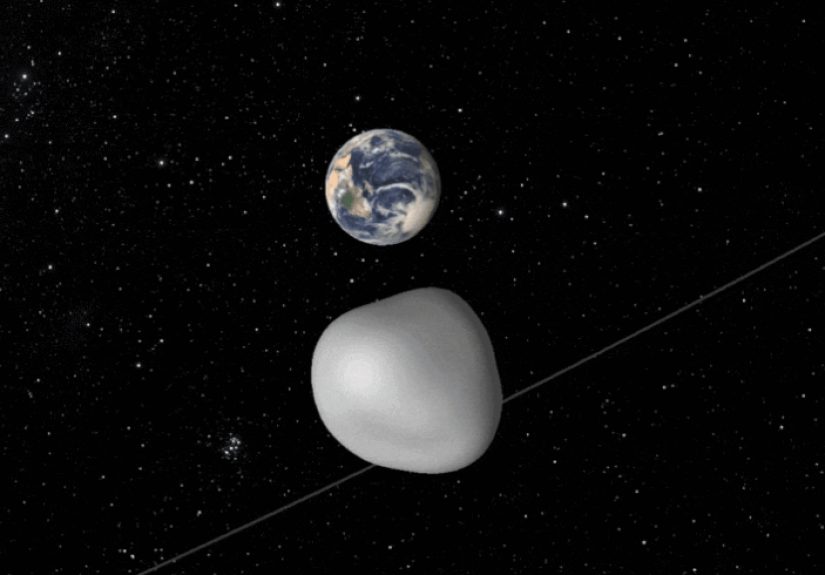
The target was the Didymos-Dimorphos binary asteroid system. Didymos is the larger body, about half a mile wide, while Dimorphos is its smaller moonlet, roughly stadium-sized. This pair was ideal because scientists could measure the change in Dimorphos’ orbit from Earth. Before impact, Dimorphos circled Didymos in about 11 hours and 55 minutes. After DART arrived, that orbit became about 33 minutes shorter.
That result mattered because the mission was not judged by whether the spacecraft hit the asteroid. Hitting the target was only step one. The bigger question was whether the impact produced a measurable deflection. It did. DART proved that a spacecraft can deliberately change the motion of a natural object in space.
Why NASA Used a Real Asteroid
Computer simulations are powerful, but space has a charming habit of refusing to follow the neatest spreadsheet. Asteroids are not smooth billiard balls. They can be loose rubble piles, solid rock, metal-rich bodies, or messy mixtures of boulders, gravel, and dust. Their shapes are often irregular. Their surfaces can behave in surprising ways. Testing with a real asteroid gave scientists data that no laboratory model could fully provide.
Dimorphos turned out to be especially interesting. Images from DART’s final moments showed a surface covered in boulders. After impact, material blasted away from the asteroid and formed a debris plume. That escaping material acted like a recoil jet, adding extra push beyond the spacecraft’s own momentum. This is one reason the orbit changed more than a simple “spacecraft hits rock” calculation might suggest.
The lesson is huge: the effectiveness of an asteroid deflection mission depends not only on the spacecraft but also on the asteroid’s structure. A dense metal object, a crumbly rubble pile, and a loosely packed boulder field might all respond differently. DART gave scientists a real data point for improving future predictions.
What Actually Happened During the Impact?
DART approached Dimorphos using autonomous navigation. That means the spacecraft had to identify its target and steer itself during the final phase. There was no joystick operator on Earth making split-second corrections. Radio signals take time to travel across space, so DART needed to make its own final decisions.
As the spacecraft closed in, its camera sent back increasingly detailed images. First the asteroid system looked like a bright point. Then Didymos and Dimorphos separated into two worlds. Finally, Dimorphos filled the view with rocks, shadows, and rough terrain. Then the image feed stopped, which was exactly what success looked like. When your mission is to crash into an asteroid, losing the signal is not a bug. It is the grand finale.
A small Italian CubeSat called LICIACube had separated from DART before impact and flew past the scene to capture images of the collision aftermath. Earth-based telescopes and space telescopes also watched the event. Together, these observations showed a dramatic spray of debris and helped scientists measure how much the asteroid’s orbit changed.
The Result: Humanity Changed an Asteroid’s Motion
The headline achievement is simple: NASA changed the orbit of Dimorphos. Before DART, the moonlet took nearly 12 hours to orbit Didymos. After the impact and follow-up observations, scientists found that the orbit had shortened by about 33 minutes. That was not a tiny laboratory effect. It was a clear, measurable shift in the motion of a real celestial body.
Even better, later research showed that the impact did not only alter Dimorphos’ motion around Didymos. Because the two bodies are gravitationally linked, the collision also slightly changed the wider Didymos system’s orbit around the Sun. The shift was very small, measured as a fraction of a second in the system’s solar orbit, but scientifically it was another sign that kinetic impact can influence asteroid motion in measurable ways.
To be clear, Didymos and Dimorphos were never dangerous to Earth, and DART did not turn them into a hazard. The mission was designed precisely so the experiment could be performed safely. NASA picked a target where the change could be measured without creating a problem for our planet.
Why Kinetic Impact Could Protect Earth
A kinetic impactor works best when there is plenty of warning time. Imagine an asteroid on a possible collision course decades from now. If a spacecraft can slightly adjust the asteroid’s velocity early enough, the asteroid may arrive at the crossing point thousands of miles away from Earth instead of directly on target. It is less like swatting a fly and more like changing a train schedule years before the train reaches the station.
This is why asteroid detection is just as important as asteroid deflection. A brilliant deflection system is not very useful if the dangerous object is found too late. NASA’s future NEO Surveyor mission is designed to improve the search for potentially hazardous asteroids and comets using infrared observations from space. Infrared detection is especially helpful because it can reveal dark objects that do not reflect much visible sunlight.
Planetary defense is a chain. Discovery is one link. Tracking is another. Impact prediction, international coordination, mission design, and public communication are also essential. DART strengthened the deflection link, but the whole chain must work together.
What DART Taught Scientists About Asteroids
DART did not just prove that NASA can hit a space rock. It also taught scientists about asteroid surfaces, debris behavior, and momentum transfer. The debris plume was not just spectacular; it was scientifically valuable. When material flew away from Dimorphos, it carried momentum in one direction, pushing the asteroid in the opposite direction. This “ejecta recoil” helped amplify the effect of the impact.
That finding matters for future mission planning. If a dangerous asteroid is a rubble pile, a kinetic impactor might produce a different result than it would on a solid object. If the surface throws off a lot of debris, the push could be stronger. If the surface absorbs impact differently, the effect could be weaker. DART gave researchers real measurements to improve computer models.
The mission also showed the value of global observation. Telescopes around the world helped measure changes in brightness as Dimorphos passed in front of or behind Didymos. These light changes revealed the moonlet’s orbital timing. Radar observations, spacecraft images, and telescope data all contributed to the final picture.
What Comes Next: Hera and NEO Surveyor
DART was the crash test. The next big step is the inspection. The European Space Agency’s Hera mission is heading to the Didymos system to study the aftermath up close. Hera is designed to measure Dimorphos’ mass, shape, surface, internal structure, and impact crater details. Those measurements will help scientists understand exactly how DART’s energy changed the asteroid.
Hera matters because DART answered the first question: Can a spacecraft change an asteroid’s motion? The answer was yes. Hera addresses the next question: Why did the asteroid respond the way it did? That deeper knowledge can turn one successful demonstration into a more reliable planetary defense technique.
Meanwhile, NASA’s NEO Surveyor is part of the detection side of the story. The mission is being developed as an infrared space telescope dedicated to finding potentially hazardous asteroids and comets. The more objects scientists find early, the more options humanity has. In planetary defense, early warning is the closest thing we have to a superpower.
Common Myths About NASA’s Asteroid Defense Test
Myth 1: NASA blew up an asteroid
Nope. DART did not destroy Dimorphos. It changed the moonlet’s orbit around Didymos. The goal was deflection, not demolition. In many real planetary defense scenarios, breaking an asteroid apart could make the problem more complicated, not less.
Myth 2: The asteroid was heading toward Earth
Also no. Dimorphos and Didymos were not on a collision course with Earth. NASA chose them because the system was safe and scientifically useful.
Myth 3: This means Earth is now fully protected
DART was a major milestone, but it was not a magic shield. Planetary defense still depends on discovering objects early, measuring their orbits accurately, understanding their physical properties, and coordinating any response internationally.
Myth 4: Asteroid defense is only a NASA issue
Planetary defense is global by nature. Space does not check passports. NASA, ESA, observatories, universities, and international partners all contribute to the work of finding, studying, and preparing for asteroid hazards.
Why This Mission Matters for Regular People
Most people do not wake up worrying about asteroids, which is healthy. Breakfast already has enough responsibilities. But DART is important because it shows that natural hazards from space can be studied and, in some cases, reduced. Unlike earthquakes or volcanoes, many asteroid impacts could potentially be predicted long before they happen.
The mission also reminds us that science is practical. Planetary defense may sound futuristic, but it depends on familiar habits: observe carefully, test ideas, measure results, improve the model, and try again. DART was not a one-day stunt. It was years of engineering, orbital mechanics, international collaboration, and patient observation compressed into one dramatic impact.
There is also a cultural benefit. DART gave the public a rare good-news space story. A spacecraft traveled millions of miles, found a small target, hit it on purpose, and gave scientists exactly the kind of data they needed. For once, the asteroid headline was not “doom approaches.” It was “we practiced, and it worked.”
Experience Notes: What This Topic Feels Like From a Human Point of View
Reading about NASA’s asteroid defense test is one thing; imagining the experience is another. The DART mission has a strange emotional flavor because it mixes comfort and cosmic scale. On the one hand, it is deeply reassuring to know that scientists are not simply staring at the sky and hoping for the best. On the other hand, the fact that we need an asteroid defense test at all makes the universe feel a little less like a screensaver and a little more like an active neighborhood.
One of the most memorable parts of the mission was the final camera view. The asteroid started as a small dot, then became a world. In the last moments, Dimorphos was no longer an abstract “near-Earth object.” It was a rough place with boulders, shadows, texture, and shape. That transformation is powerful. A thing that had been a number in a database suddenly looked real. Then the signal stopped. For a spacecraft designed to hit its target, silence meant success.
There is also something wonderfully human about the mission’s style. DART was not elegant in the way a telescope is elegant. It did not gently orbit, land, scoop, or sample. It arrived like a very expensive bowling ball with a PhD committee. Yet behind that blunt action was extraordinary precision. The mission required navigation, timing, engineering, and scientific planning at a level that makes “just crash into it” sound hilariously unfair.
The topic also changes how people think about risk. Asteroids are easy to exaggerate because movies trained us to imagine fireballs and countdown clocks. But the real story is calmer and more useful. Scientists are not waiting for the final hour. They are building catalogs, improving telescopes, testing deflection methods, and studying asteroid behavior long before a crisis appears. That is the grown-up version of planetary defense: less screaming, more spreadsheets, and thankfully, better math.
For students, science fans, and casual readers, DART is a perfect example of why space exploration matters beyond curiosity. Studying asteroids teaches us about the early solar system, but it can also help protect civilization. That combination is rare and exciting. It is both ancient history and future safety, packed into one rocky object orbiting another rocky object millions of miles away.
The biggest takeaway is not that NASA can “fight” asteroids. It is that humanity can learn, test, and prepare. DART was a rehearsal, and rehearsals matter. Nobody buys fire extinguishers because they plan to burn dinner, although some of us do keep them nearby after meeting certain toaster ovens. Planetary defense works the same way. You hope never to need the emergency plan, but you build it anyway because responsible species do responsible things.
Conclusion
NASA’s test of an asteroid defense system with a real asteroid was one of the most important space achievements of the modern era. DART proved that a kinetic impactor can change the motion of an asteroid in a measurable way. By striking Dimorphos and shortening its orbit around Didymos by about 33 minutes, the mission gave scientists real evidence that asteroid deflection is possible.
But DART was not the end of the story. It was the beginning of a more mature planetary defense era. Follow-up missions like Hera and future detection tools like NEO Surveyor will help scientists understand asteroids better and spot potential hazards earlier. The message is not that Earth is invincible. The message is better: we are learning how to be prepared.
For a mission that ended with a spacecraft crashing into a rock, DART was surprisingly graceful. It showed that with enough warning, enough science, and enough international cooperation, humanity may be able to turn a future asteroid threat into a near miss. And honestly, making giant space rocks miss Earth is the kind of group project everyone can support.